FUEL ECONOMY GUIDES
How to Split Gas Money for a Road Trip Fairly

To split gas money for a road trip, work out the fuel used for the shared driving, agree who pays a share, and divide the cost between those people. When someone joins halfway, split each leg separately. Keeping a record of who paid at the pump also makes the final reimbursement much easier.
How to Split Gas Money for a Road Trip
For an equal split, your trip's fuel cost is divided by the number of people paying, with the driver included or excluded according to what your group agreed before departure.
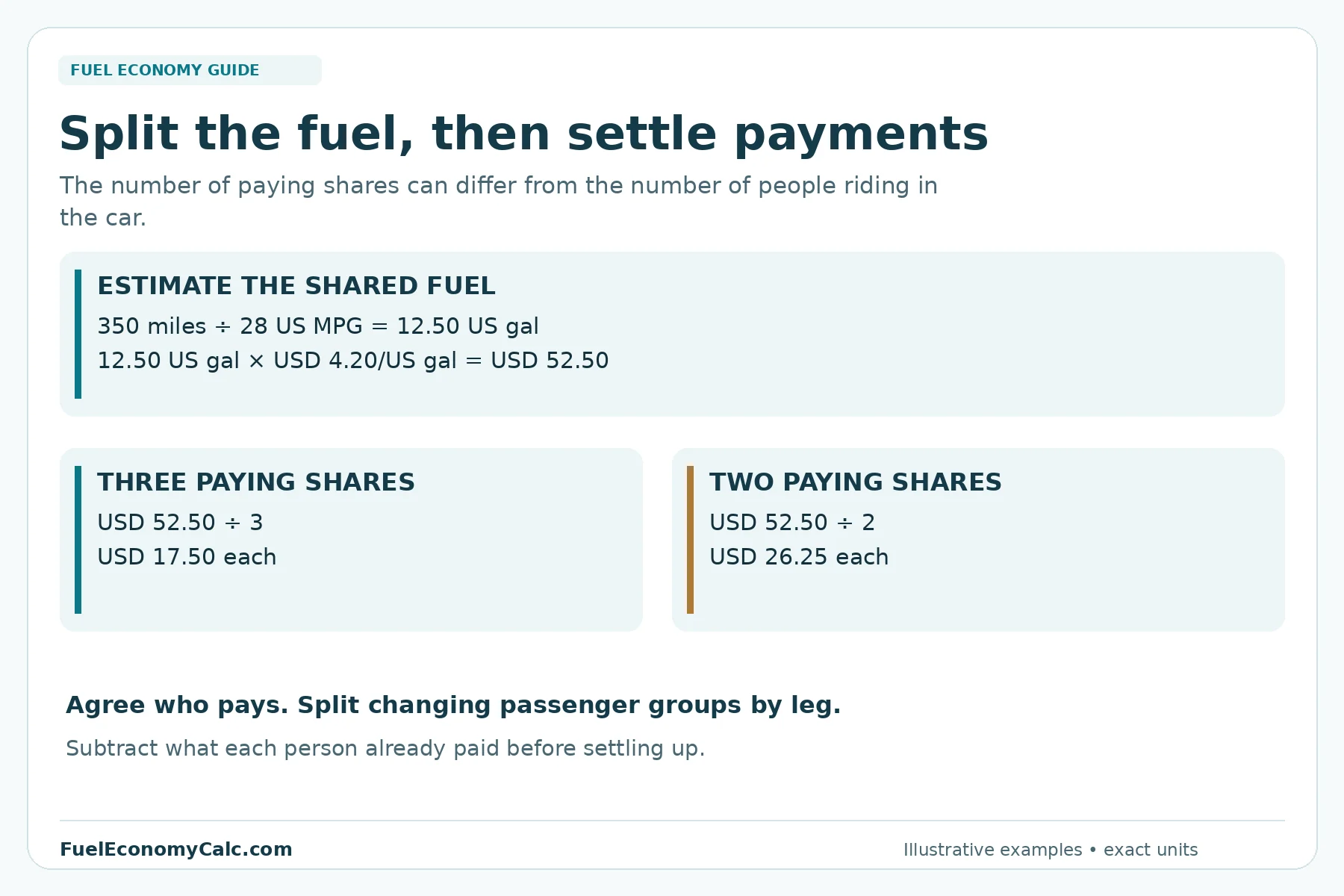
For example, on a hypothetical 350-mile trip at 28 US MPG and $4.20 per US gallon, you'll use 12.5 gallons costing $52.50. Three people sharing equally pay $17.50 each, while two passengers covering the whole fuel bill pay $26.25 each.
Your count needs to distinguish between people riding and people paying. In our calculator, the traveler count is the number of equal shares you want. You would enter two in the second arrangement even though three people are riding in the car. That small label difference changes each person's result.
You can discuss tolls, parking and any contribution toward using the car separately, then add the agreed amounts afterward so everyone can still see what the fuel itself cost.
Estimate Before Leaving, Then Settle the Shared Fuel
Your initial budget needs distance, expected MPG and a clearly stated fuel price, using miles ÷ US MPG × price per US gallon. Until you know what was paid, that price remains an assumption in your plan.
Include the correct distance
For instance, if your route is 350 miles each way, a return trip covers 700 miles, while a planner already showing 700 miles for the entire journey has included both directions.
You can include known detours in your entered distance and use an MPG figure from comparable driving when you have one. Weather, traffic and loading may also change your fuel use. Their effect varies enough that a single added percentage would give different groups a misleading sense of precision.
Match the fuel to the shared trip
Receipts work well when you start and finish at comparable tank levels and record all purchases between them. FuelEconomy.gov's full-to-full method explains why matching distance and fuel is useful.
If your car starts nearly empty and you fill it before leaving, charging the group for that entire first purchase can include fuel left for your later personal use. Starting and ending at a similar level avoids that mismatch. Alternatively, your group can agree to use a distance-based estimate and keep that basis clear when settling up.
Keep price differences visible
When you buy fuel at several prices, your matched purchases' actual amounts give you the total cost, whereas averaging posted prices gives equal influence to stations where you bought different volumes.
For example, buying two gallons at one station and twelve at another means the second price affects much more of your fuel bill.
For an estimate with different trip legs, you can calculate each leg using its expected price and add the totals. You don't need a new calculator page or an account to keep that record.
The calculation below is 350 miles ÷ 28 US MPG × USD 4.20 per US gallon = USD 52.50. Each paying share equals total fuel cost ÷ number of paying shares, giving USD 52.50 ÷ 3 = USD 17.50 or USD 52.50 ÷ 2 = USD 26.25.
Divide Each Leg by the People Who Rode It
When your passenger group changes, each leg's fuel cost needs its own agreed paying group. A person riding one way may owe a different amount from half the whole-trip share, because the legs can have different costs and different numbers of people.
Imagine you're driving this hypothetical trip and paying a share, with two friends riding outbound but only one returning:
| Leg | Fuel cost | People sharing | Each person's share |
|---|---|---|---|
| Outbound | $36.00 | 3 | $12.00 |
| Return | $40.00 | 2 | $20.00 |
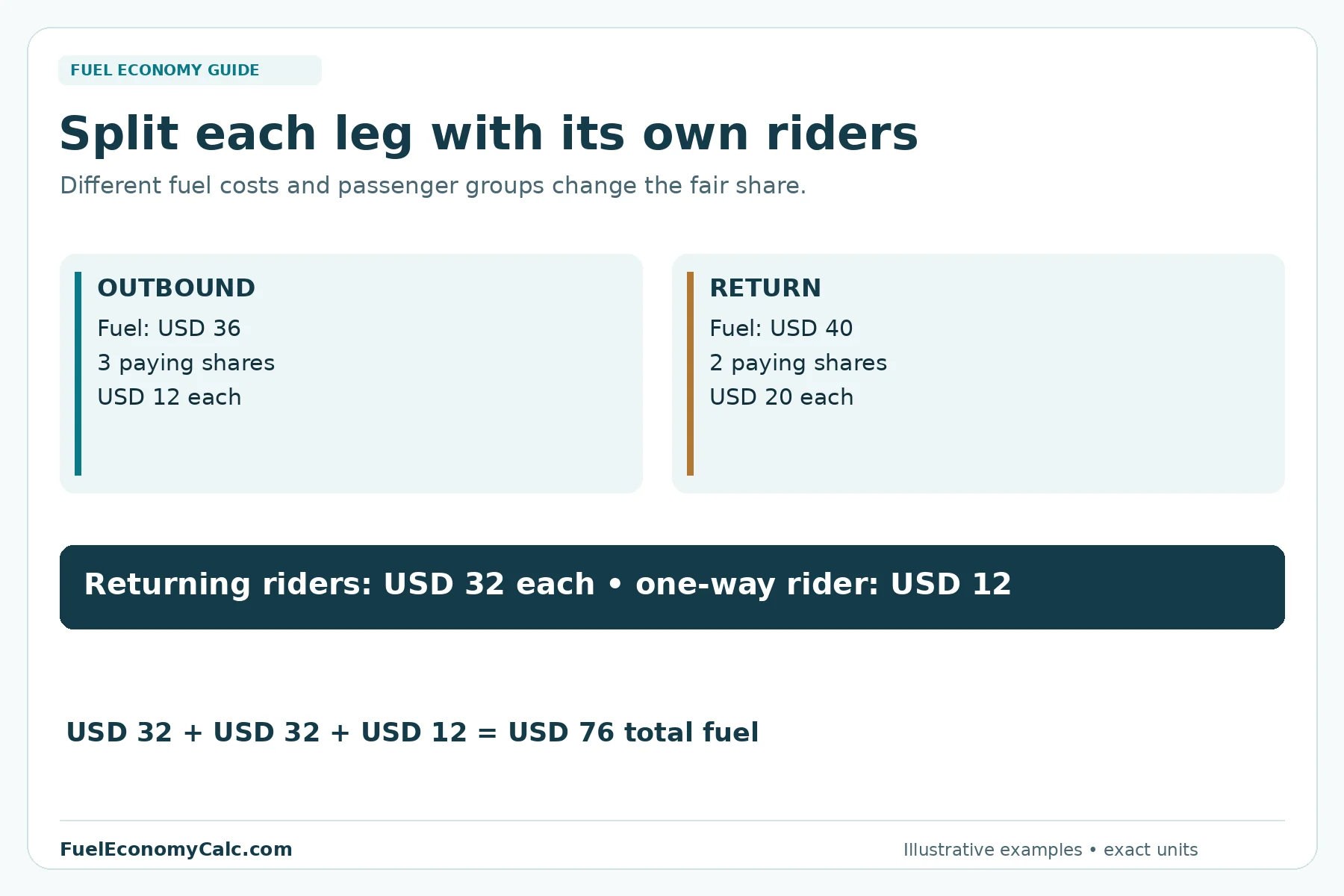
In this example, you and the returning friend each owe $32, while the outbound-only friend owes $12, bringing all three shares to the $76 fuel total.
The outbound-only person owes less than half of $32. More people shared that leg, and it also cost less. Your leg-by-leg calculation accounts for both differences instead of assigning everyone the same price per journey.
You can use the same approach for someone joining midway through your outward journey, dividing it at the pickup point and calculating the shared cost for each part. Also, a detour made only for one person's benefit is easier to handle when you've agreed its treatment beforehand.
In the diagram, each returning rider's share is USD 36 ÷ 3 + USD 40 ÷ 2 = USD 32. The one-way rider pays USD 36 ÷ 3 = USD 12, and USD 32 + USD 32 + USD 12 = USD 76 checks against the total.
Reimburse Whoever Paid More Than Their Share
Your settlement balance is the amount you actually paid minus your assigned share, with a positive balance meaning you should receive money back and a negative balance meaning you still owe money.
In the $76 example, suppose the driver paid $60 at the pump and the returning friend paid $16. Their shares are still $32 each, while the third person owes $12.
| Person | Paid already | Assigned share | Final position |
|---|---|---|---|
| Driver | $60 | $32 | Receives $28 |
| Returning friend | $16 | $32 | Pays $16 |
| Outbound-only friend | $0 | $12 | Pays $12 |
The two payments of $16 and $12 reimburse the driver exactly, so your group can settle the trip without repaying a separate share of every individual receipt.
For totals that divide unevenly, you'll also need to reconcile the final cents. For example, splitting $50 three ways can mean $16.67, $16.67 and $16.66. Three independently rounded $16.67 amounts would collect one cent too much.
Agree on the Rules Before Departure
Your group needs a short agreement, not a complicated expense policy. Decide whether the driver pays fuel, which costs are shared, how you'll handle someone riding only partway and whether you'll settle an estimate or matched actual spending.
Use the Fuel Cost Calculator for the fuel estimate and equal-share result. If you're unsure which MPG to enter, the dashboard accuracy guide can help you compare it with your own refill records. Keep tolls, parking and other agreed costs visible separately.
Frequently Asked Questions
Should the driver pay for gas?
That's a choice for the group. Including everyone gives an equal split. Having passengers cover fuel recognizes the driver's contribution in a different way. Agree before the trip, then use the number of people actually paying when you divide.
Do I divide by passengers or everyone in the car?
Divide by the number of agreed paying shares. Include the driver if the driver pays. If only passengers pay, leave the driver out of that count. Make the label clear in your written calculation.
Is the per-person result the amount I must transfer?
It's your assigned fuel share before subtracting anything you already paid. If you bought fuel during the trip, compare that payment with your share to work out whether you owe money or should receive reimbursement.
Can I use a mileage reimbursement rate instead?
You can agree on a separate contribution, but don't call a broader mileage allowance fuel cost. It may cover costs beyond gasoline. This website's calculator estimates liquid fuel only, with no official reimbursement entitlement or vehicle-ownership allowance.