Fuel Range Calculator
Estimate distance from fuel available, your fuel economy and an explicit reserve. Enter the fuel quantity directly, or estimate it from tank capacity and an indicated percentage. See the fuel available, the amount set aside and the usable range separately.
Calculator
Inputs
Results
Enter your available fuel (or tank capacity and gauge percentage), reserve fuel and fuel economy to estimate usable driving distance.
Unable to calculate: Correct the highlighted fields to view fuel range estimates.
- Equivalent usable range
- —
- Range before reserve (total available)
- —
- Usable fuel (available minus reserve)
- —
- Available fuel evaluated
- —
- Reserve fuel excluded
- —
Mathematical planning estimate only, not a distance guarantee. Speed, traffic, cold temperatures, terrain and gauge inaccuracy can substantially reduce actual range. Plan to refuel well before empty.
How to Use the Fuel Range Calculator
Choose Available fuel if you have a quantity to work with. Choose Tank and gauge to multiply capacity by the indicated level. Enter your efficiency in US MPG, Imperial MPG, L/100 km or km/L.
Set a reserve in the same selected fuel unit. The default of zero means the calculation excludes no reserve. It isn't a recommendation to use every drop. A reserve larger than the available quantity produces an error, while a reserve equal to it gives zero usable range.
Gauge-based fuel is an estimate. A displayed half tank doesn't establish an exact measured volume, and a tank's advertised capacity doesn't tell you precisely how much usable fuel remains now.
Range Formula: Available Fuel Minus Reserve
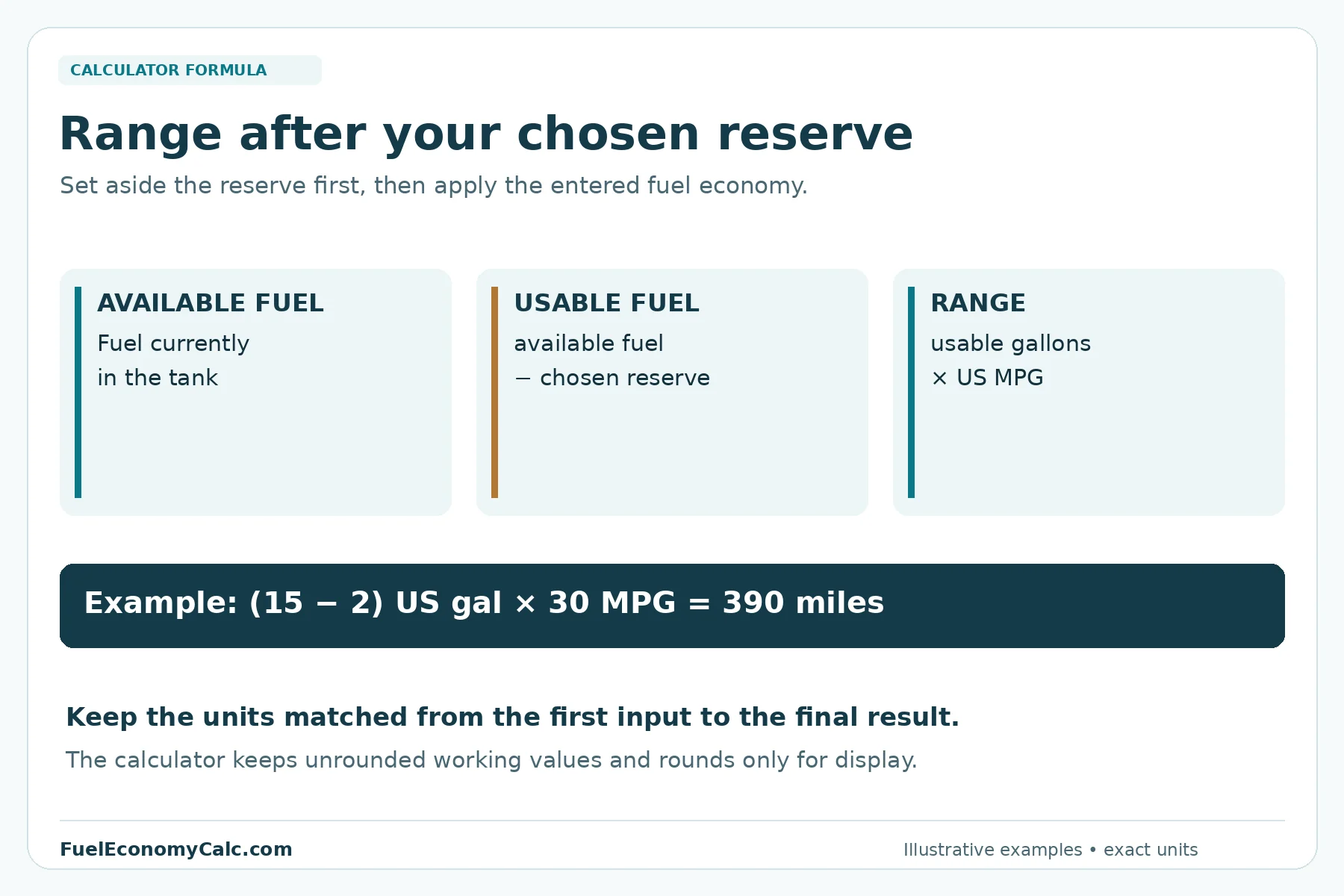
For matching gallon units, range in miles = (available gallons − reserve gallons) × MPG. For liters and L/100 km, range in km = usable liters ÷ L/100 km × 100.
| Step | Hypothetical US-unit example |
|---|---|
| Available fuel | 15 US gal |
| Entered reserve | 2 US gal |
| Fuel used for the estimate | 13 US gal |
| Economy | 30 US MPG |
| Usable range | 13 × 30 = 390 mi |
| Range before excluding reserve | 15 × 30 = 450 mi |
These two ranges answer different questions. The primary result excludes the reserve you entered. The before-reserve number helps you see its effect, without suggesting that the extra distance is safe to rely on.
In the graphic, usable fuel = 15 − 2 = 13 US gallons, then estimated usable range = 13 × 30 = 390 miles. The reserve is excluded before the distance is calculated.
The NIST conversion reference underpins the mile, liter and gallon conversions. US and Imperial gallons remain distinct throughout the result.
Estimating Fuel From Tank Capacity and Gauge Level
Multiply capacity by the indicated fraction before subtracting reserve. For an entered capacity of 20 US gallons at 50%, available fuel is estimated as 10 gallons. With a two-gallon reserve and 30 US MPG, usable range is (10 − 2) × 30 = 240 miles.
That arithmetic doesn't certify the gauge's accuracy or assume it changes linearly in your vehicle. Consult the owner's manual for its display behavior, tank information and refueling warnings. Use a directly measured or otherwise better-supported available quantity when you have one.
The result's fuel bar separates usable fuel from reserve. Its labels show actual quantities so you can read the breakdown without relying on color or interpreting a dashboard-style needle.
Why Real Driving Range Can Change
Traffic, speed, terrain, weather and load can change fuel economy after you make the estimate. A recent highway average may overstate what you can expect in a slow urban queue.
In its 2021 study of in-dash fuel estimates, AAA found range estimates varied as driving conditions changed. That supports treating distance-to-empty as an estimate, rather than treating its change as measured fuel consumption.
No universal reserve or off-road penalty is inserted here. Plan refueling with your vehicle instructions, route and conditions in mind. The calculator doesn't locate a fuel station, guarantee a detour allowance or recommend driving to empty.
Choose the Right Starting Efficiency
Use a measured figure from similar driving when possible. The Fuel Economy Calculator can work from distance and fuel records. If you have a rating in another unit, the Fuel Economy Converter shows its equivalent without changing the physical efficiency.
For a budget rather than remaining distance, use the Fuel Cost Calculator. Keeping those tasks separate avoids confusing how far the fuel might take you with what a refill or trip will cost.
Frequently Asked Questions
How many miles can I drive after the fuel light turns on?
This tool can't determine that from the warning light alone. You need an available-fuel quantity and an appropriate economy figure, and both may be uncertain. Follow your vehicle's refueling guidance and don't assume another model's reserve applies.
Does a zero-mile dashboard range mean the tank is empty?
Not necessarily, but it doesn't establish a dependable extra distance either. Display behavior varies by vehicle and conditions. This calculator doesn't turn an unknown remaining amount into a safe driving recommendation.
Can I use a reserve percentage?
The tool asks for a fuel quantity so its meaning stays visible. If you want to set aside a chosen percentage, calculate that quantity from your entered available fuel first. No percentage is presented as universally safe.
Why is the reserve in gallons or liters rather than miles?
It separates the fuel you plan to leave unused from the fuel included in the estimate. The distance that quantity represents changes with efficiency. Showing the reserve as a volume makes that assumption easier to check.