FUEL ECONOMY GUIDES
Dashboard MPG Accuracy: How to Check Your Car’s Reading
You can check dashboard MPG accuracy by comparing its average with a full-to-full calculation over the same driving interval. Reset timing, gallon definitions and refill consistency all matter. Before you assume the display or pump is wrong, make sure both numbers describe the same miles and fuel.
How to Check Dashboard MPG Accuracy
You can check the display by resetting its average at a full refill, driving normally and comparing that average with miles divided by the gallons needed to restore the starting level. You'll need both readings before the next reset.
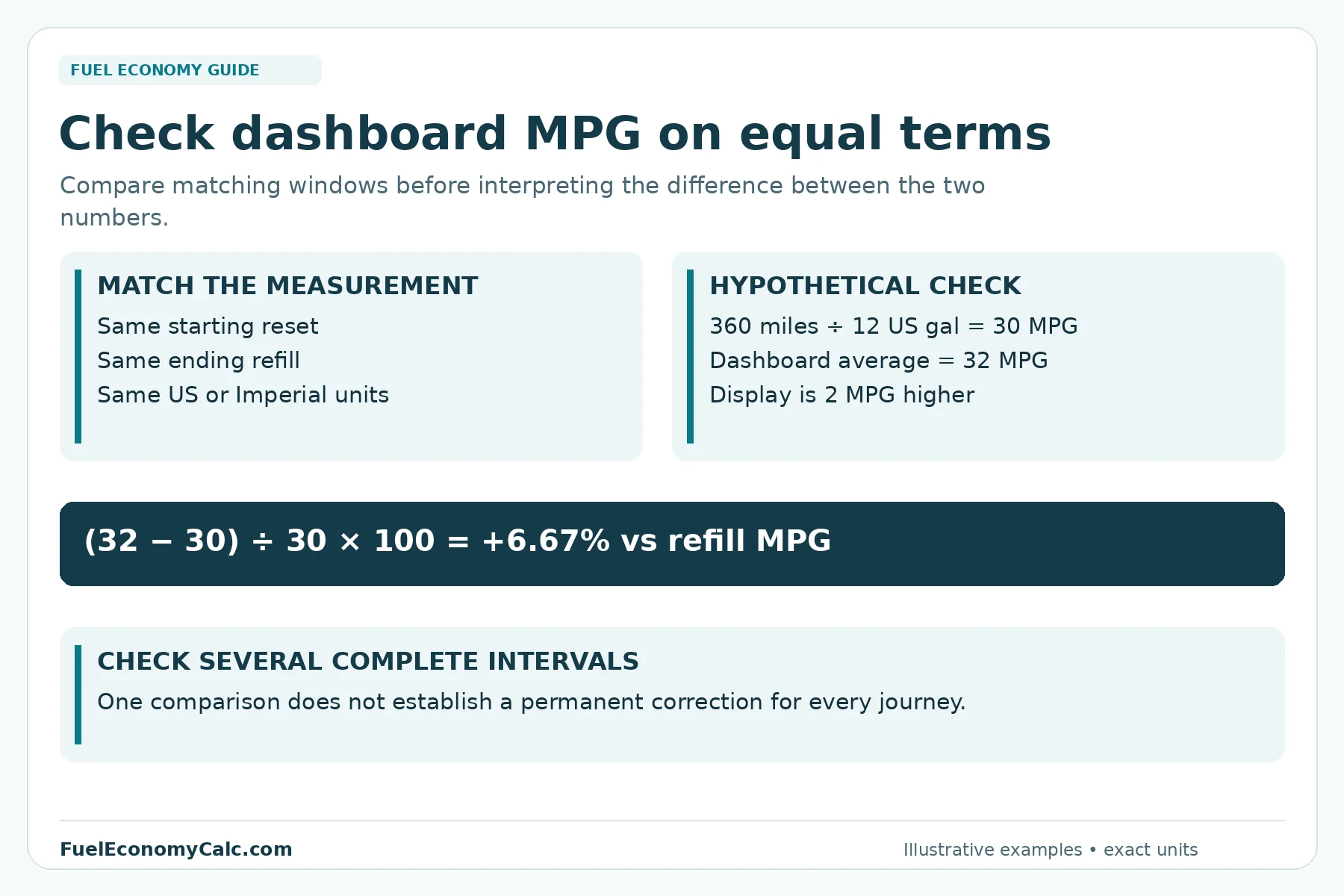
For example, if you drive 360 miles and refill with 12 US gallons, your hand calculation is 30 US MPG. A dashboard reading of 32 US MPG for that same interval is 2 MPG higher, or about 6.67% above your refill calculation.
That gives you a check on this interval. Your next comparison may show a different gap, because both the vehicle estimate and the refill measurement have limits. Keeping several matching records helps you see how the readings behave across your usual driving.
An AAA study of sixteen vehicles published in July 2021 found an average absolute difference of 2.3% between displayed and laboratory-measured economy across its testing. Individual vehicle results ranged from 0.0% to 6.4%. “Absolute” counts the size of a difference regardless of its direction. Your vehicle may behave differently from the models and conditions in that study.
Compare the Same Driving Interval
The two numbers become useful when they cover the same driving, since your lifetime dashboard average and a single-tank calculation can both be reasonable while describing quite different journeys.
Reset the average at the starting fill
Your owner's manual identifies the average-fuel-economy screens and their reset behavior. Some cars have several trips, an average since refueling and another since the last reset. You'll want to note which one you're using before you begin, so the closing reading comes from the same record.
At your starting full refill, record the odometer and reset that average while parked, keeping a note if another reset happens later.
Also, if the display resets automatically at refueling, your vehicle's instructions will determine when to read it at the closing stop, before the information you wanted to compare is replaced.
Record the closing refill before changing anything
Your closing record needs the fuel volume, ending odometer and displayed average from the final comparable full refill. The official full-to-full MPG procedure gives you the distance-and-fuel calculation to compare against that display.
Any intermediate fuel purchases belong in the same interval's total. If you lose a purchase or accidentally reset the trip display, you can mark that comparison as incomplete and begin another one. A guessed missing number may produce a percentage, but it removes the independent measurement you're trying to make.
Match the gallon definition
You'll also need to check whether your display uses US or Imperial MPG before comparing it with an app or website. Imperial gallons are larger, so the same physical economy produces a higher Imperial MPG number. For example, 30 US MPG is about 36.03 Imperial MPG. Matching that definition can resolve an apparent difference before you investigate anything else.
The infographic uses 360 miles ÷ 12 US gallons = 30 US MPG as the refill measurement. A dashboard reading of 32 MPG is higher by (32 − 30) ÷ 30 × 100 = 6.67%, measured against the refill result.
Why Dashboard MPG and a Hand Calculation Differ
Your dashboard estimates fuel economy from vehicle data, while your refill calculation uses recorded distance and replacement fuel volume, giving you two measurement paths that can be affected by how the numbers are collected.
Different reset windows
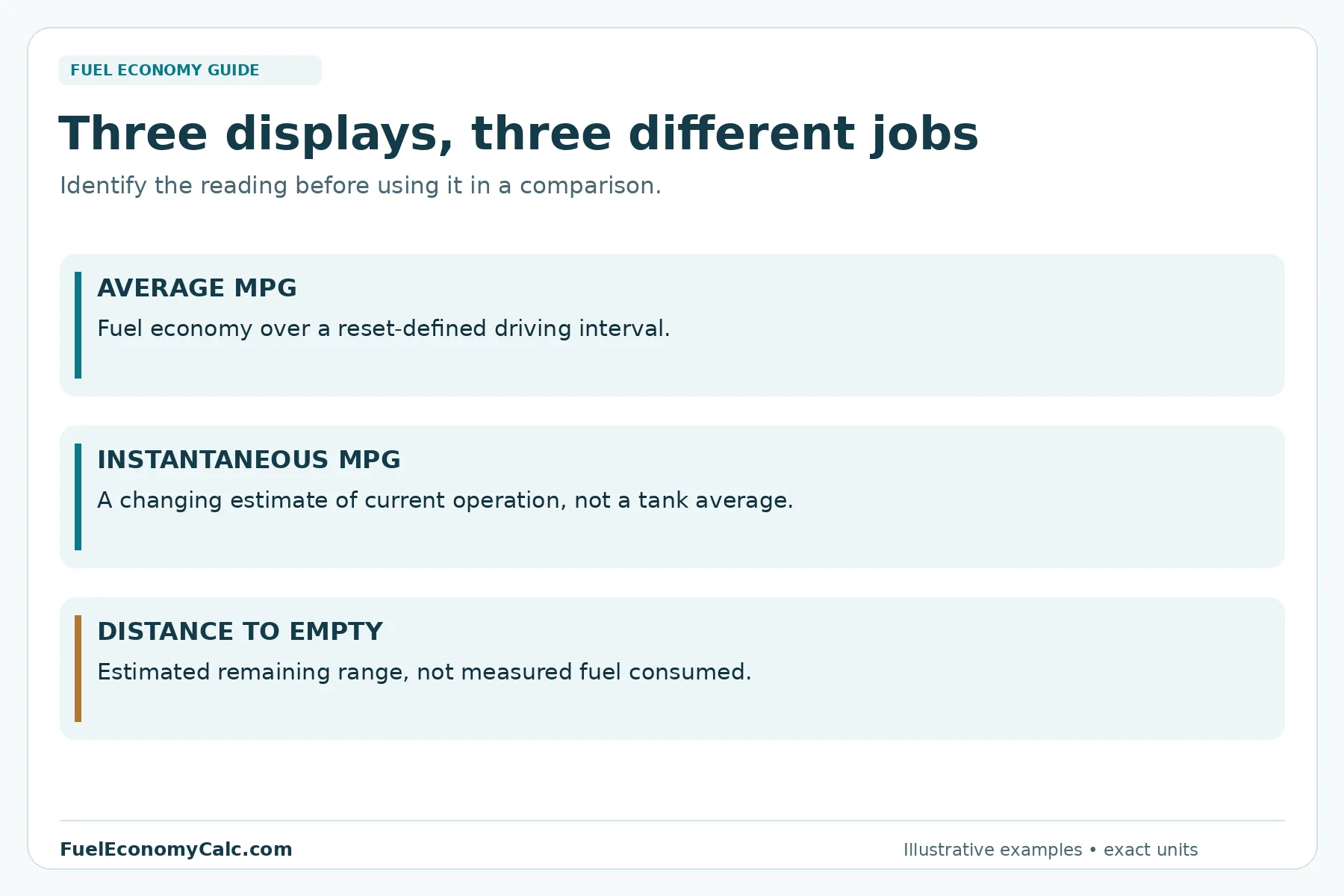
For instance, your dashboard average may still include last month's highway trip when you're checking this week's city driving. The distance or time attached to the selected memory can help you spot that mismatch. The average over a tank also needs to be compared with an average screen, rather than an instantaneous MPG reading.
Instantaneous readings can rise or fall quickly as you accelerate, coast or idle, describing a different job from the average you're checking over your complete refill interval.
Your owner's manual explains what the particular screen means and how its settings work. If you photograph the readings for your record, doing it while parked also lets you check the screen label and selected unit later, alongside the fuel receipt.
Refill and recording variation
A different final fuel level changes the gallons used in your hand calculation, as does a missing intermediate fill, a transposed odometer digit or accidentally entering tank capacity instead of refill volume.
Your original records are useful here. The guide to partial fill-ups explains how small purchases fit into a complete interval, and several valid intervals let you see whether the gap persists or changes direction. That gives you more context before you apply a correction.
Driving conditions changed
Recent speed, stop-and-go traffic, temperature and load can change real fuel economy. So a display based on recent conditions may move even when the remaining fuel changes very little, especially when you're switching between different kinds of driving.
For context, FuelEconomy.gov's cold-weather guidance reports roughly 15% lower city MPG for a conventional gasoline car at 20°F than at 77°F, with larger effects on short trips.
That weather comparison explains a change in driving conditions, rather than giving you a correction factor for the dashboard in your own car.
Calculate the Gap Without Inventing a Correction
The formula (dashboard MPG − refill MPG) ÷ refill MPG × 100 expresses the display's difference relative to your refill measurement, with a positive answer meaning the display is higher and a negative answer meaning it's lower.
For the 32-versus-30 example, your calculation is 2 ÷ 30 × 100 = 6.67%, while dividing by 32 instead gives 6.25% because you have changed the reference number.
Naming that comparison basis makes the percentage useful to someone reading your record later. For instance, “display above the refill calculation” identifies which number you're checking and which number you're using as the reference.
| Quantity | Hypothetical value |
|---|---|
| Distance | 360 mi |
| Refill | 12 US gal |
| Refill calculation | 30.00 US MPG |
| Dashboard average | 32.00 US MPG |
| Difference relative to refill MPG | +6.67% |
One tank gives you a starting comparison rather than a permanent adjustment. An early pump shutoff can influence that refill, and your display's behavior may differ across driving patterns. You can retain the raw readings and review several matching intervals before choosing a number for your budget. Also, keeping the original readings lets you revisit a suspected recording mistake without losing the rest of your log.
Choose a Number That Fits Your Budget
A well-kept refill history can give you a practical baseline for similar future driving. The average MPG guide shows how to combine those intervals without giving short and long tanks equal weight.
Use the Fuel Economy Calculator to calculate a matched interval. If the vehicle develops warning lights, fuel smells, leaks or a major unexplained change, follow the owner's manual and seek appropriate service rather than trying to diagnose it from this comparison alone.
Frequently Asked Questions
Does a higher dashboard MPG prove the pump overcharged me?
No. The two readings alone don't isolate the cause of a difference. Check the interval, units and refill records first. A specific concern about a dispenser requires the relevant station and local weights-and-measures process.
Can I calculate MPG from the fall in miles to empty?
No. Distance to empty is a changing range estimate, not a measured quantity of fuel consumed. Dividing miles driven by the change in that display doesn't produce a valid MPG measurement.
Should I reset MPG every time I start the car?
Only if you want the average for that particular trip. To compare a dashboard reading with a tank interval, align the reset with the interval's start and leave it unchanged until the closing measurement. Check your manual for automatic-reset settings.
Is the same accuracy percentage valid for every model?
No. The AAA research covered a specific set of vehicles and test conditions. It doesn't certify another model, a modified vehicle or every individual journey. Check your own matched records instead of assuming one universal margin.