FUEL ECONOMY GUIDES
How to Average MPG Over Multiple Tanks Correctly

Your average MPG over multiple tanks comes from adding the original miles and fuel volumes, then dividing total miles by total gallons. You'll get a figure that gives every gallon its proper weight. Averaging the displayed MPG numbers can give a different answer, especially when one fill covers much more driving than another.
How to Find Average MPG Over Multiple Tanks
The formula is combined MPG = total miles ÷ total gallons consumed, with each row in your record covering a complete, non-overlapping interval of matching fuel and distance.
For refill measurements, comparable full tanks give you a useful start and finish. FuelEconomy.gov's measurement instructions explain how to record the readings and refill volume. Once you have several valid intervals, you can combine their underlying miles and gallons.
You're finding how far your vehicle traveled for each gallon used across the whole record. Your original miles and gallons retain that relationship. A list of dashboard MPG values loses the sizes of the intervals behind it, which makes those values harder to combine correctly.
The totals method also makes your calculation easy to check, because you can point to the distance sum, fuel sum and final division without relying on a hidden weighting setting.
Why Unequal Tanks Need the Totals Method
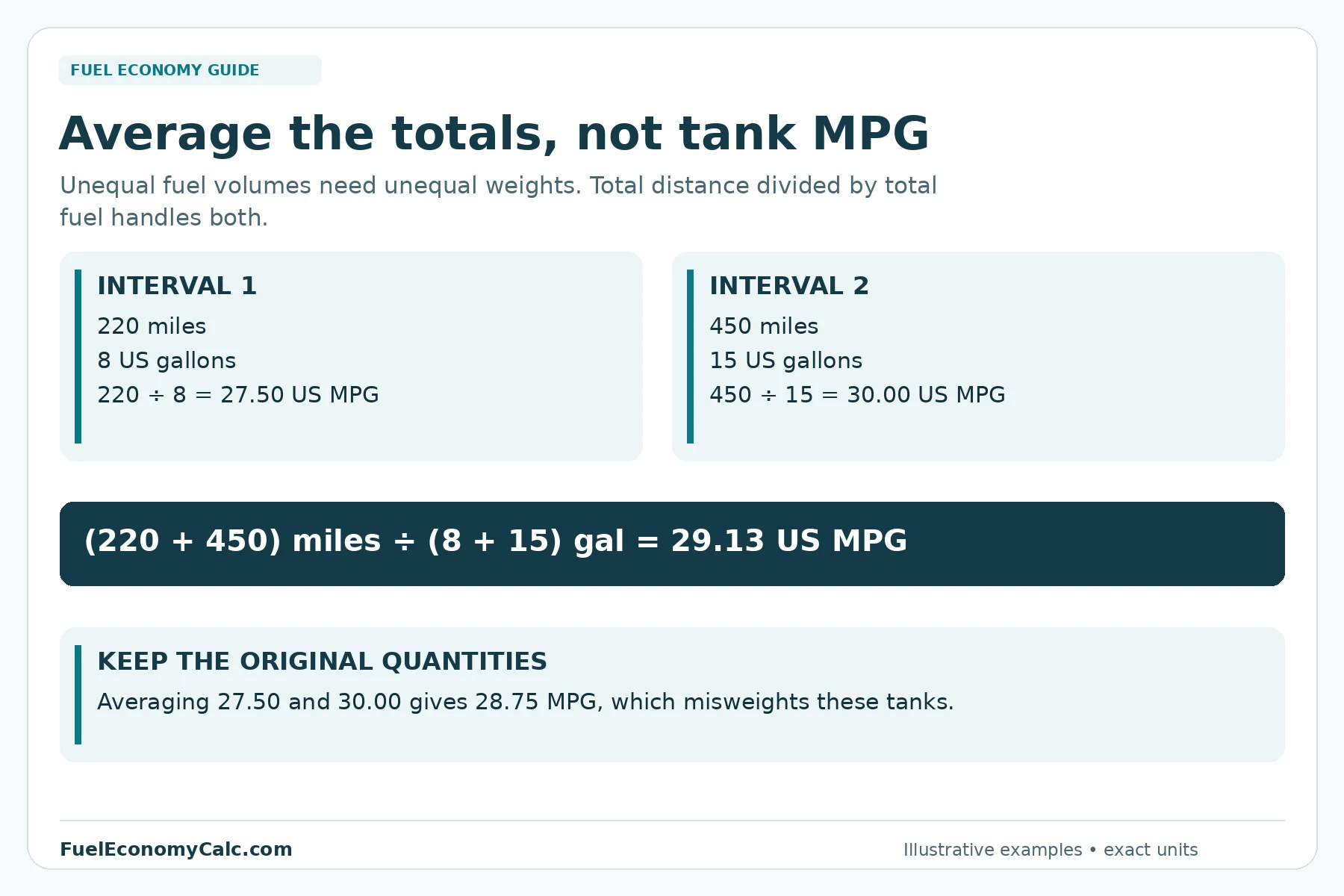
Unequal fuel volumes mean each interval should contribute a different amount to the final MPG. Consider this hypothetical record, with US gallons throughout:
| Completed interval | Miles | US gallons | Interval MPG |
|---|---|---|---|
| First | 220 | 8 | 27.50 |
| Second | 450 | 15 | 30.00 |
| Combined | 670 | 23 | 29.13 |
Your combined figure is 670 ÷ 23 = 29.1304 MPG. Averaging 27.5 and 30 gives 28.75 MPG. That gives the eight-gallon interval the same influence as the fifteen-gallon interval, even though you used almost twice as much fuel in the second one. The totals calculation preserves that difference.
You can also express the correct calculation as a fuel-weighted average, multiplying each interval's MPG by its gallons, adding those results and dividing by total gallons. But when you've already recorded miles and gallons, adding your original values is simpler and avoids unnecessary rounding.
For instance, at a hypothetical 12,000 miles and $4 per US gallon, your correct 29.1304 MPG implies about $1,647.76 in fuel. The incorrect 28.75 MPG implies about $1,669.57. Your car and fuel price stayed the same. The averaging method created that budget difference.
The infographic's total is (220 + 450) miles ÷ (8 + 15) US gallons = 29.13 US MPG, rounded to two decimals.
Equal Distance and Equal Fuel Give Different Shortcuts
You can average the MPG figures directly when every interval uses exactly the same fuel volume, but an equal-distance record needs a different calculation because its fuel volumes can differ.
When each interval uses the same gallons
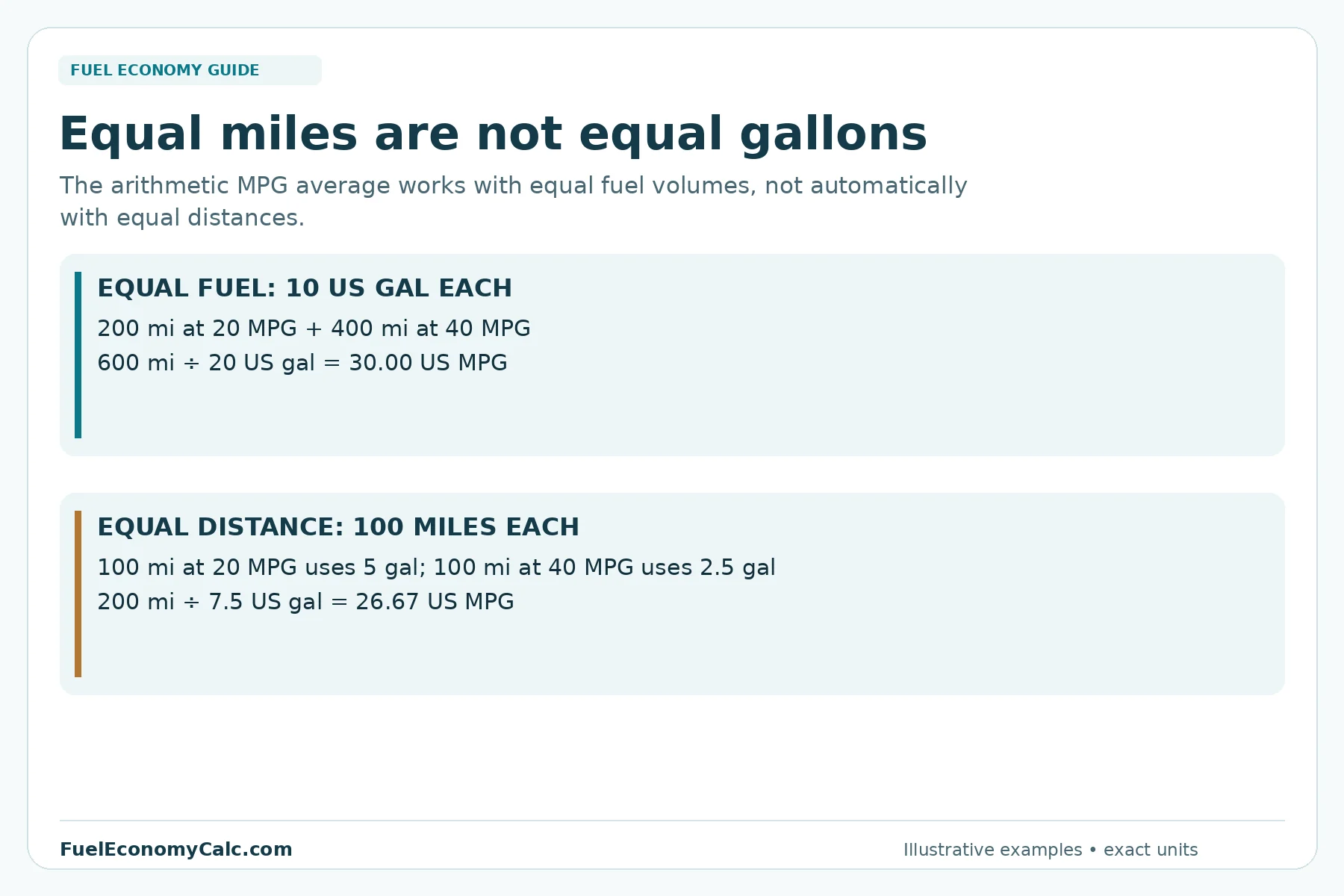
For example, if you use ten US gallons at 20 MPG and another ten at 40 MPG, you cover 200 miles in the first interval and 400 in the second. Your combined result is 600 miles divided by twenty gallons, or 30 MPG.
The simple average of 20 and 40 also happens to be 30, because the fuel weights are equal in this example. But your actual refills may have different volumes, even when you describe each one as “a tank.” You can check the recorded gallons before deciding whether this shortcut applies.
When each interval covers the same miles
If you instead drive 100 miles at 20 MPG and another 100 at 40 MPG, the two legs use five and 2.5 gallons respectively. Your combined economy becomes 200 divided by 7.5, or 26.67 MPG.
The 30-MPG arithmetic average would overstate your result. When you have distances and MPG values, you can calculate each leg's fuel first using combined MPG = sum of miles ÷ sum of (miles ÷ MPG). This is the distance-weighted harmonic calculation, which accounts for the greater fuel used on the lower-MPG leg.
When your units differ
Your quantities need matching units before you total them. You can add miles to converted kilometers and US gallons to converted liters, as long as your gallon definition identifies US or Imperial. NIST's conversion-factor reference provides the definitions behind those conversions.
Also, L/100 km points in the opposite direction from MPG, with a lower figure meaning less fuel used over a fixed distance. Once your original fuel and distance quantities use matching units, you can express the combined result in whichever form you need.
The two diagram cases are (200 + 400) miles ÷ (10 + 10) gallons = 30.00 MPG for equal fuel, and (100 + 100) miles ÷ (5 + 2.5) gallons = 26.67 MPG for equal distance.
Keep a Useful Long-Term Fuel Record
Keeping each row's miles and fuel alongside its MPG lets you rebuild your total later, while a record of rounded MPG alone may lose the information needed to combine intervals accurately.
Your useful fields include the start and end readings, fuel volume and unit, full or partial status, and notes about missing entries. You can also note mostly highway driving or unusual idling. These details help you understand what the record covers, without treating an MPG change as a diagnosis by itself.
Your rows also need separate measurement windows. For example, an interval covering Monday through Friday overlaps another covering Wednesday through Sunday. Some driving would be counted twice. Consecutive complete intervals, or one longer closed interval covering all purchases, avoid that duplication.
When a record contains intermediate partial fills, their volumes belong in that interval's total before you close it. The partial-fill MPG guide shows how to identify the endpoints and separate an incomplete record from the intervals you can measure.
Use Your Average for the Right Kind of Planning
Your total describes the driving you recorded, so a long highway holiday can pull your annual MPG upward even when next month's stop-and-go commute is likely to use more fuel per mile.
You can keep separate complete-interval totals for useful driving patterns, with each total labelled to show the journeys it covers. For instance, your commuting record may be more useful for next month's work trips than the total from a highway holiday. The Fuel Economy Calculator combines completed matched intervals, and the Fuel Cost Calculator turns a suitable result into a trip or recurring budget.
Also, retaining the original MPG precision through the cost calculation keeps your budget consistent with the distance and fuel measurements, with rounding left for the final displayed amount.
Frequently Asked Questions
Is a longer tank automatically weighted more?
The correct MPG average is weighted by fuel consumed, so a longer interval's distance alone doesn't establish its weight even though longer driving often uses more fuel. Adding total distance and total fuel handles both quantities correctly.
How many tanks do I need for a reliable average?
There isn't one required count that guarantees accuracy for every driver. Several complete intervals give you more context than one unusual refill. Check that the records are complete and representative of the driving you want to estimate.
Can I combine two cars into one MPG figure?
You can divide both vehicles' total miles by their total fuel to describe the combined record. Keep it labelled as a fleet or two-car figure, because it won't describe either vehicle individually. Don't average their displayed MPG values without the underlying quantities.
Can I average monthly averages?
Use each month's original miles and gallons, then combine those totals. Giving every month equal weight can distort a year when you drove far more in some months than others. The same rule applies to weekly and yearly summaries.