FUEL ECONOMY GUIDES
How to Calculate MPG With Partial Fill-Ups
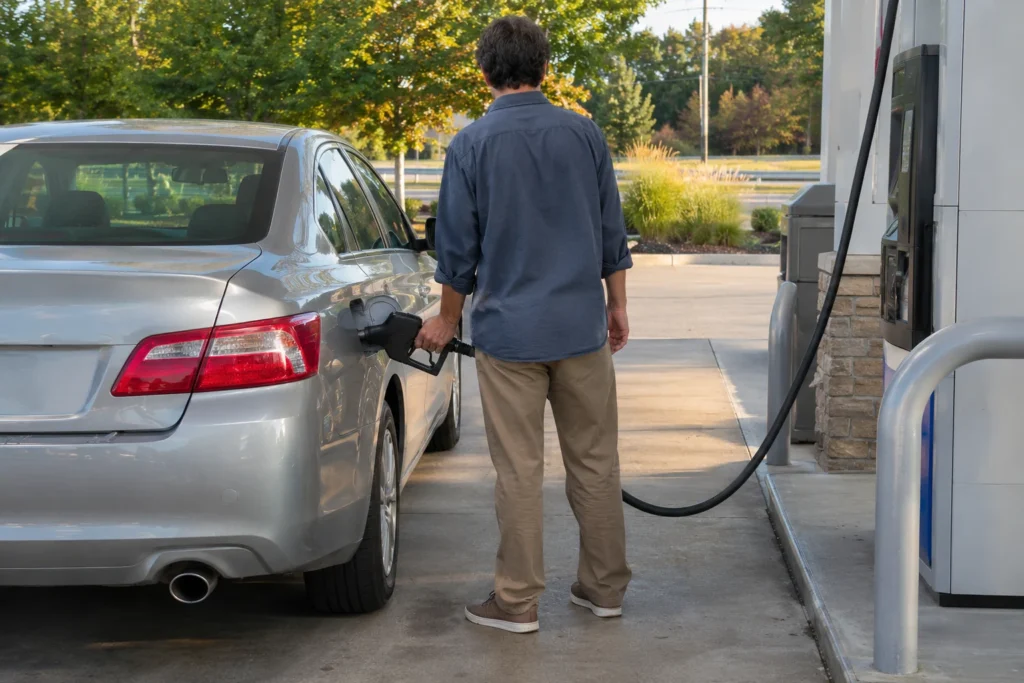
You can calculate MPG with partial fill-ups if you record every fuel purchase between two comparable full tanks. A single partial purchase usually doesn't tell you how much fuel you burned. The useful number comes when you close the interval, add up its gallons and match them to the miles driven.
Can You Calculate MPG With Partial Fill-Ups?
Yes. Start with a full tank, record all fuel added afterward, and finish with another full tank at a comparable level. Your MPG is the distance between those full endpoints divided by all the fuel added after the start, including the final refill.
This works because restoring your starting fuel level lets the purchases stand in for the fuel consumed across the whole interval, even when you bought that fuel at several different stops.
FuelEconomy.gov's My MPG guidance makes the same useful distinction between recording a fuel purchase and having enough information to calculate an MPG estimate. You can keep a purchase in your log even when it doesn't close a full-tank interval.
The first fill establishes your starting level. Its gallons belong to the driving before that point, so your new interval starts with the odometer reading and a fresh fuel total. You'll add the later purchases to that total. Keeping the starting fill on a separate line makes this easier to check when you return to your notes.
Record a Closed Full-to-Full Interval
You'll need the starting odometer reading, the ending reading and the volume from every fuel stop in between, using the same gallon definition or converting each purchase before you add it.
Set the starting point
You can record the odometer when you fill normally and mark that entry as your start. If you're using the trip meter, this is also the point to reset it. Take the reading while parked, before leaving the station. That gives you a clear baseline without trying to photograph or reset the display while driving.
Your next full refill needs a comparable stopping point. Squeezing in extra fuel to make the gauge look more exact introduces a different endpoint, so follow your vehicle's normal refueling instructions.
Keep the partial purchases
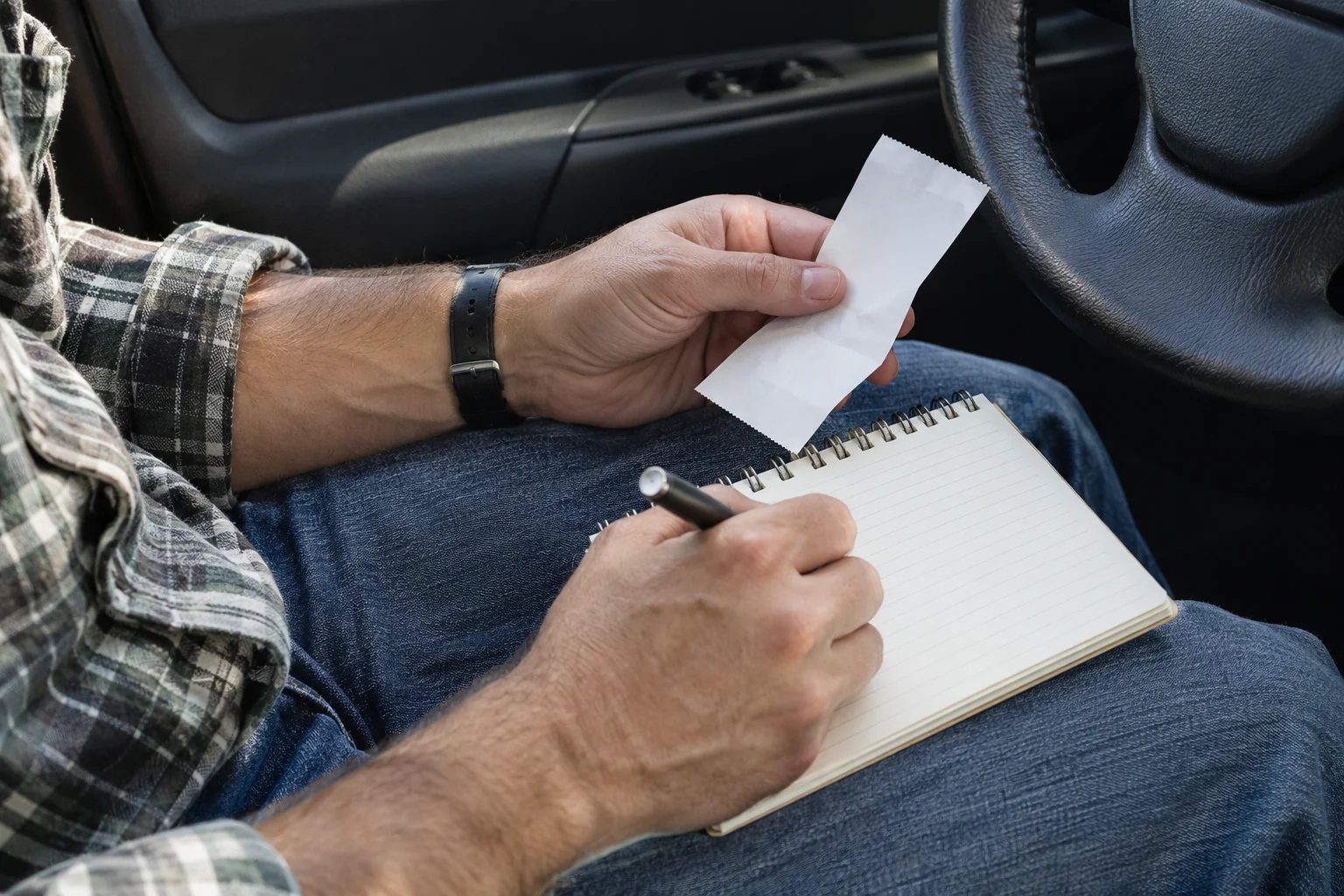
Each time you buy fuel, write down its gallons or liters and keep the receipt until you've checked the entry, even if you added only a small amount.
Also, fuel added from another source belongs in your record. For instance, if you add a measured quantity from a suitable fuel container, those gallons help cover the recorded miles too. A log that includes the distance but misses that fuel will show an inflated MPG figure.
The odometer at a partial stop can help you check the sequence, but it doesn't make that stop a complete measurement. You still don't know the tank's exact fuel level at that point.
Close the interval
At your next comparable full refill, you can subtract the starting odometer from the ending reading and add every purchase after the start through that final refill. Dividing those miles by the total US gallons gives your US MPG.
FuelEconomy.gov explains the odometer subtraction and MPG method. The partial-fill version simply keeps all purchases inside the same closed interval.
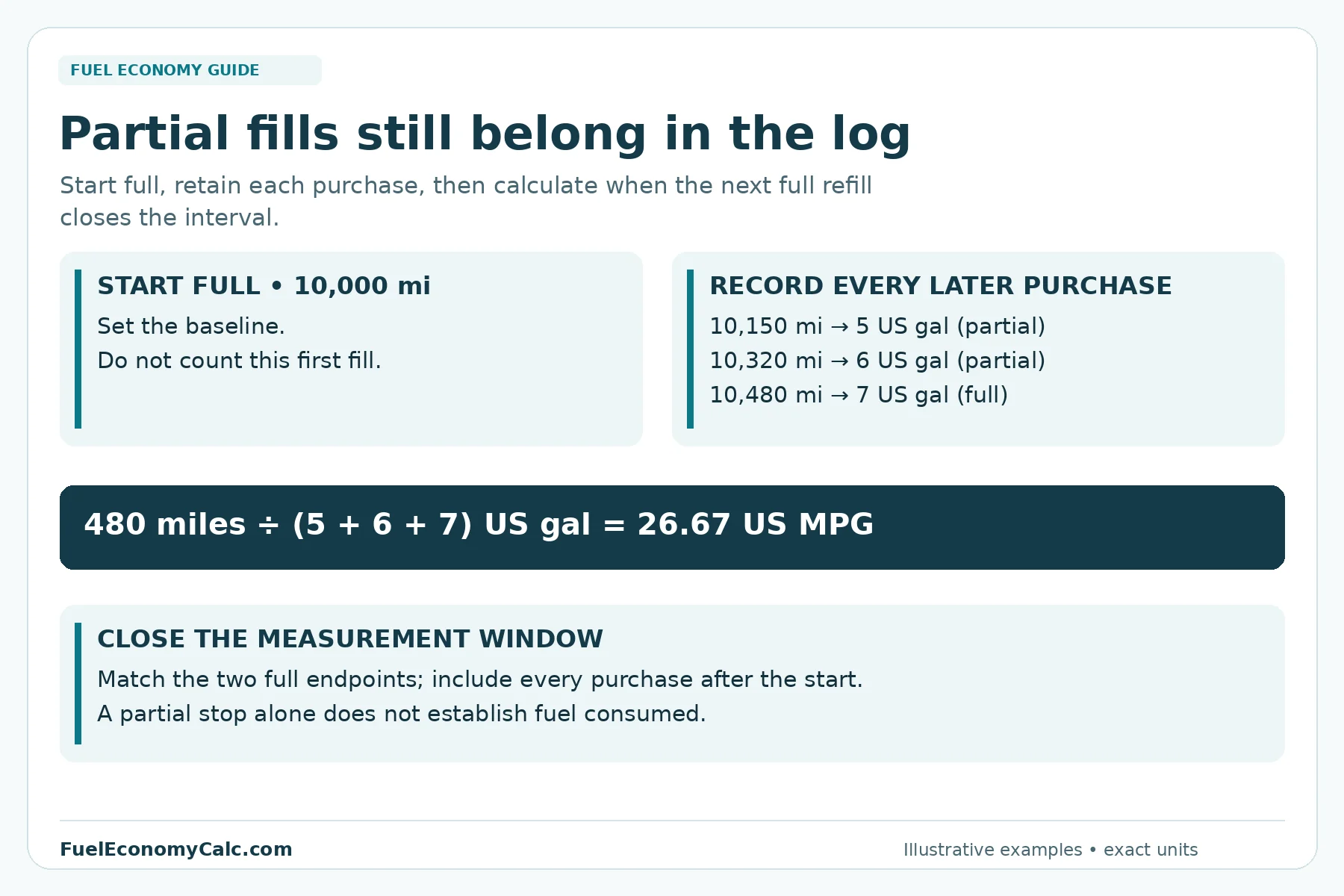
For the log below, MPG = (ending odometer − starting odometer) ÷ fuel bought after the starting fill. The complete interval gives (10,480 − 10,000) ÷ (5 + 6 + 7) = 26.67 US MPG.
A Worked Fuel Log With Two Partial Purchases
Your closed interval can include any number of recorded partial stops. Here's a hypothetical example using US gallons:
| Stop | Odometer | Fuel added | How to use the entry |
|---|---|---|---|
| Starting full tank | 10,000 mi | Not counted | Establish the baseline |
| Partial purchase | 10,150 mi | 5 US gal | Include in the fuel total |
| Partial purchase | 10,320 mi | 6 US gal | Include in the fuel total |
| Closing full refill | 10,480 mi | 7 US gal | Include and close the interval |
You drove 10,480 − 10,000 = 480 miles. Fuel added after the start was 5 + 6 + 7 = 18 US gallons. Your measured economy is 480 ÷ 18 = 26.67 US MPG.
Dividing the first 150 miles by the five-gallon purchase would give 30 MPG. That number isn't established by this record, because the tank wasn't restored to its starting level at that stop. The five gallons purchased need not equal the fuel consumed over those 150 miles.
The same bookkeeping works with liters. If you record kilometers and total liters, your consumption is total liters divided by total kilometers, multiplied by 100. Keeping the original volumes through the final calculation avoids rounding each purchase into gallons first.
What If a Receipt or Tank Level Is Missing?
You'll need a new reliable baseline when missing fuel prevents you from closing the interval, because a longer log still needs every purchase inside the endpoints you've chosen.
One purchase is missing
Your payment record may help if it shows the volume purchased. A dollar total alone needs the applicable unit price and any discounts or other items before you can recover gallons. Today's posted price may be different from what you paid. For this reason, the original receipt is much more useful than a later price estimate.
If you can't recover the fuel volume, you can mark the affected interval as incomplete and start again at a known full refill, keeping that gap out of your measured MPG.
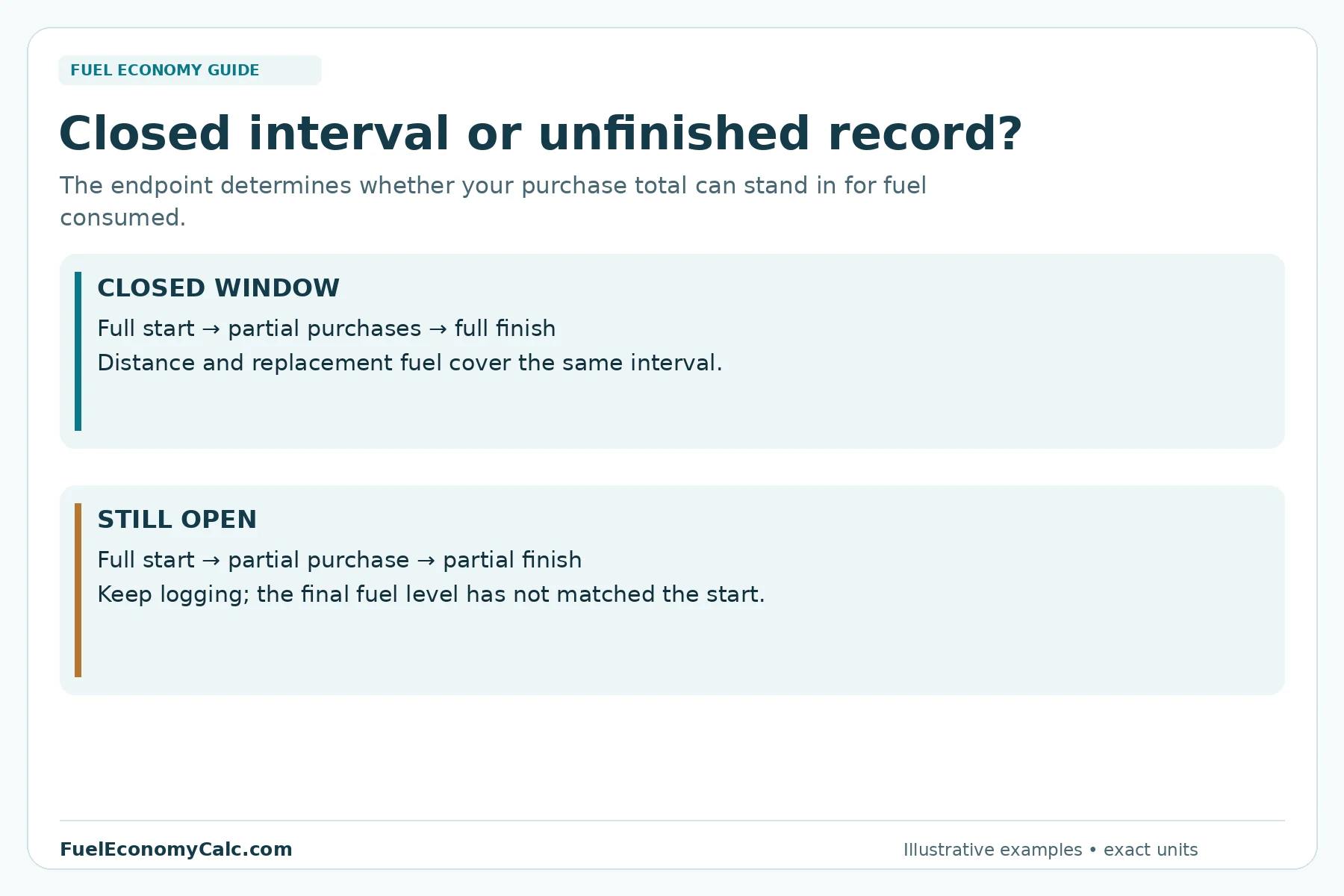
Your final stop is another partial fill
You can keep recording purchases until the next comparable full refill closes the interval. Your spending record is useful immediately, but the MPG calculation still needs matching endpoints. Also, a gauge reading such as “half a tank” gives you an estimate of level rather than a measured volume.
The starting and ending levels differ
A lower ending level leaves some consumed fuel unreplaced, making the purchase total too small. A higher ending level includes fuel that wasn't burned during the interval. Either mismatch changes the calculated MPG.
This is why you can refuel before the tank gets low: the measurement depends on matching the endpoint levels, rather than reaching a warning light or using the tank's advertised capacity.
Use the Completed Interval in Your Calculator
Once you have the closing refill, you can enter the total miles and all fuel added after the start in the homepage calculator. Starting and ending odometer readings work there too. Your receipts or notes stay with you as the source record, since the tool calculates the interval without saving a fuel log.
For several complete intervals, combine the original distance and fuel totals. The guide to averaging MPG over multiple tanks explains why averaging the MPG figures themselves can distort the result. Enter your closed interval in the Fuel Economy Calculator when you're ready to check it.
Frequently Asked Questions
Can I calculate MPG from a $20 fuel purchase?
Only if you know the fuel volume and have a matching measurement interval. The dollar amount by itself measures spending. Even a known gallon quantity doesn't close a partial-fill interval unless you also know how the starting and ending fuel levels relate.
Does the first full tank count toward the MPG total?
Its volume is excluded from the interval that starts there. Record its odometer reading as the baseline, then count fuel added afterward through the closing full refill. That keeps the fuel aligned with the miles you're measuring.
Do I have to use the same station every time?
No. You can record purchases from different stations. Comparable refill levels and complete volume records matter more than the station name, and several valid intervals can help you see whether one refill was unusual.
Can a partial fill still be useful for a fuel budget?
Yes. You can record the amount spent immediately. Keep that spending record separate from measured fuel consumption until you have a closed interval, especially if some of the purchased fuel remains in the tank.